
2005/11/22
Neighborhood #329
My street rules!-- The covered sidewalk that runs for several blocks has speakers that play music all day. This evening's selection: The Arcade Fire.
First time I've heard that here!
First time I've heard that here!

Visitas às escolas primárias
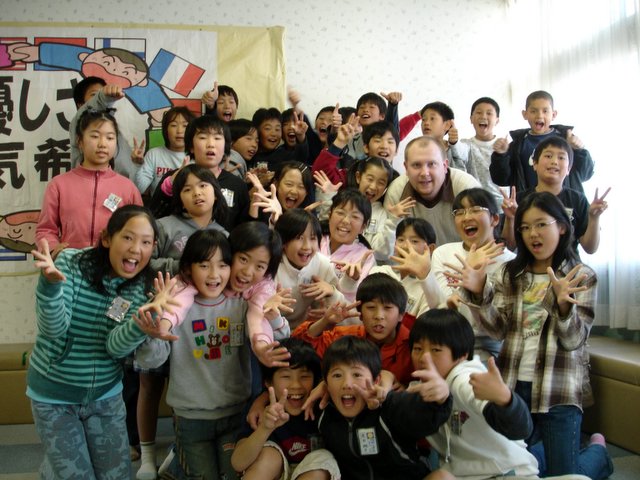
 I've been visiting elementary schools a lot lately. There are four of them that I visit with varying frequencies, though I never see a given class of kids more than once in a semester.
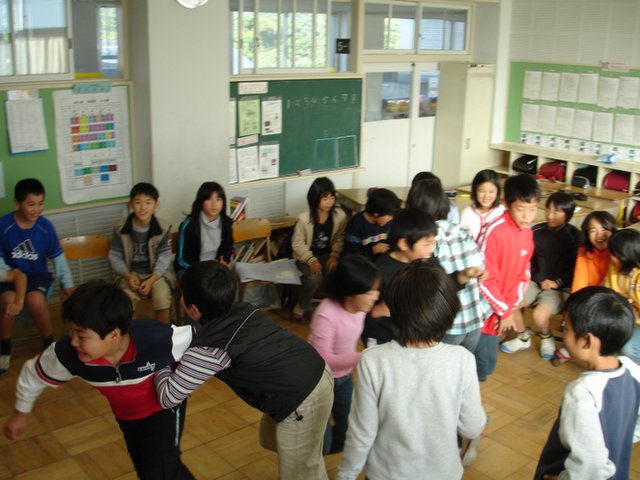 So far I've taught some fourth, fifth, and sixth grade classes, though I did have a Halloween party at one school in which the whole school participated (It's a tiny school, with as few as 10 students per grade.) All the kids have been super-genki, happy and full of energy. They get very excited about having a foreign teacher, and almost all of them participate very enthusiatically in the lesson, something which is quite a relief after teaching at junior high all the time. Regarding my base school, at least, I don't understand what it is that happens between sixth grade and the first year of junior high that turns down the overall enthusiasm so much and causes some of them to completely lose their ability to follow directions, rules, or common sense. These elementary school kids are great, and a few of them speak better English than anyone at either of my junior highs.
 Click to enlarge
2005/11/21
神原下
木曜と金曜は朝早く神原下って言うバス停から学校へ歩いて行く。
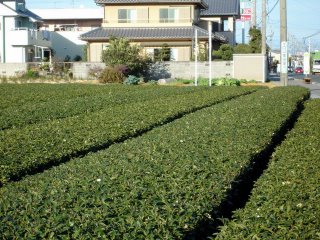

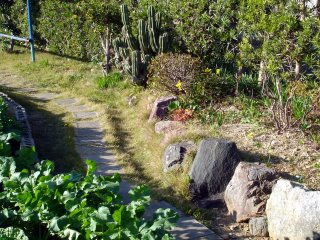
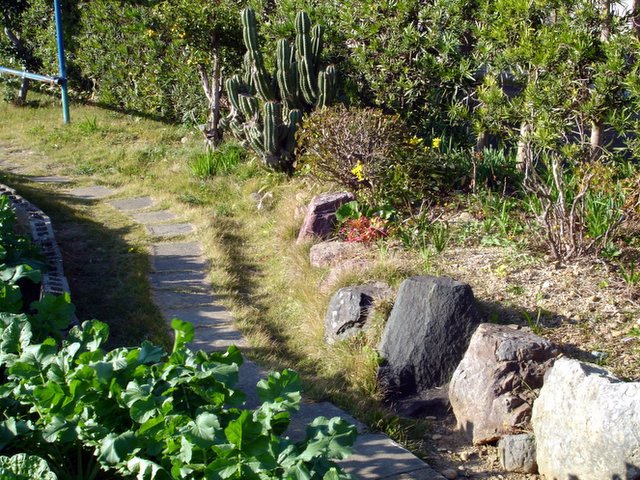
To get to one of my schools in the morning, I catch a bus at 6:50 and ride for 25 minutes, and then I have to walk for almost 20 minutes. The whole neighborhood is full of small farms. Above left is a field of green tea, for which this prefecture is famous. Above right is an orchard of mikan trees. Sometimes I see passing elementary kids looking for a mikan they can reach through the fence... Click to enlarge

They also grow a lot of lettuce, cabbage, kale, and other greens.


In the picture above on the right, the fields go right up to my school's grounds.

Nas quinta- e sexta-feiras tenho que andar à pé por 20 minutos entre a parada de ônibus e a escola onde trabalho. Tem muitas fazendas por lá de chá verde, produto famoso desta região, de mikan, um tipo de laranja pequena e doce, e também de lechuga e outros vegetales verdes.


To get to one of my schools in the morning, I catch a bus at 6:50 and ride for 25 minutes, and then I have to walk for almost 20 minutes. The whole neighborhood is full of small farms. Above left is a field of green tea, for which this prefecture is famous. Above right is an orchard of mikan trees. Sometimes I see passing elementary kids looking for a mikan they can reach through the fence... Click to enlarge

They also grow a lot of lettuce, cabbage, kale, and other greens.

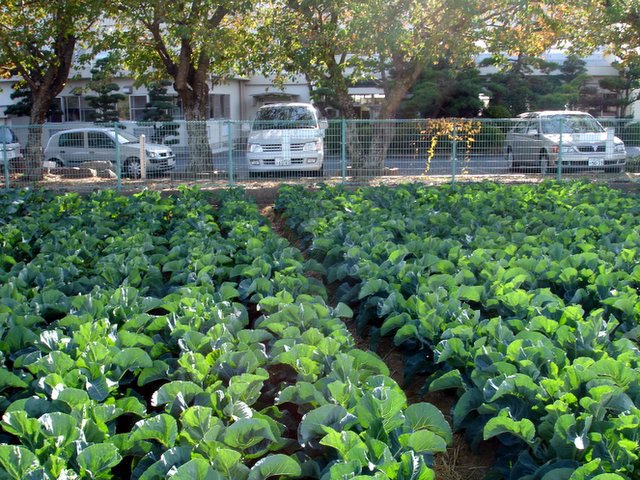
In the picture above on the right, the fields go right up to my school's grounds.

Nas quinta- e sexta-feiras tenho que andar à pé por 20 minutos entre a parada de ônibus e a escola onde trabalho. Tem muitas fazendas por lá de chá verde, produto famoso desta região, de mikan, um tipo de laranja pequena e doce, e também de lechuga e outros vegetales verdes.
2005/11/20
Body Remover
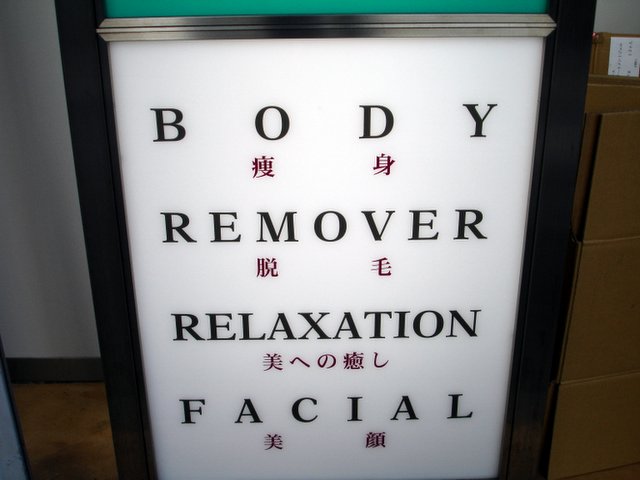
If any of you need to dispose of a body, just relax-- I know a little place that'll take care of that really cheaply.
Hamamatsu at night

The sun sets about 5PM these days... I had a long, rather chilly walk this evening and took these photos.

Can you guess what this is?

This is a long park-type space stretching north from Act Tower.
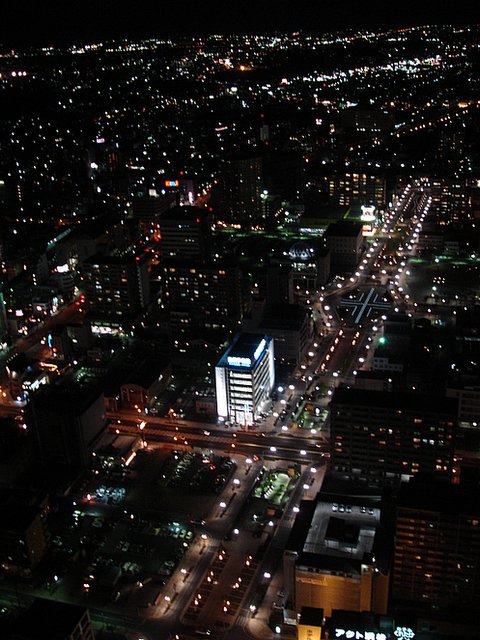
I went up to the 45th floor of Act Tower and took these last two. The one above is a bird's-eye view of the same park space in the previous picture.

The round building in the foreground is the main bus station. The blue and green building across from that is the Forte Building, which houses Hamamatsu's international center, among other things.
2005/11/17
Pachelbel, Pavlov, Muzak, and the catchy fish song...
Pachelbel's Canon will forever take me back to lunchtime in the Japanese school staff room, with children shitsureshimasu-ing in and out, and a tray of cold fried fish or little cold gray weiners in front of me, with a half-pint of that slightly cardboard-flavored Japanese milk. I'm not sure if that's what Pachelbel had in mind or not, but he is a sort of pre-recorded dinner bell for us every day at my base school, followed by some Verdi overture, before Vivaldi sounds the call to recess. In the afternoon we know it's cleaning time when Mendelsohn comes in with his Italian Symphony, and then that's it, until Bach starts up his Morning Meeting Brandenburg #3 at 8:05 the next day. Every day there it's the same program. I don't know if it's intended as some kind of Pavlovian conditioning to spur the kids into action or what. I almost think there would be an uproar if they played Pachelbel early in the morning-- kids might start circling their desks and getting out their chopsticks and placemats. At my other schools, a similar musical routine takes place, though each school has a different repertoire. One of my schools lets the kids listen to their Backstreet Boys or Orange Range or whatever, after the let's-get-ready-for-lunch tune is over, but an apparent over-arching rule of Japan is still at work: Everything must have a theme song.
It's not at all limited to schools. In the grocery store, in addition to the store jingles, you might find a little tape player next to the deli section looping a song about how korokke is watashi no oishii tomodachi, "my delicious friend," or the mushrooms in the produce section singing in a low voice, "Kinoko koko kono genki no ko..." The fish song was actually a real radio pop song several years ago. I can't understand much beyond "sakana sakana sakana" because of the high-pitched voices and my underdeveloped Japanese ability, but I am told that it extols the nutritional virtues of fish. Sickeningly catchy too.
One of my first impressions of Japan was in the bullet train station in Okayama, where every time a train arrives the intercom plays a Japanese-cutesy-ized Muzak version of "I've Been Working on the Railroad," all round bouncy synth tones. After being in Tottori for a while I noticed that not only would they play the same song on repeat in the train station for weeks at a time, but the special tourist bus which heads hourly for the sand dunes blares, everywhere it goes, a special cartoony theme song which was composed specifically as the Tottori Sand Dunes theme song. I can't recall it at the moment, but I'm sure if I heard it now, a flood of memories would come rushing back of random things I was thinking about when I heard the bus go by on a daily basis.
What is especially strange to me is the seeming ease with which the Japanese can become used to and/or completely tune out all the theme songs around. Particularly the people who work around them. The bus I ride every morning turns off its engine every time it stops for more than 10 seconds or so, and when it does it plays quite terrible toy-keyboard-demo-style Musak. If I were a bus driver I would never turn off the engine, because there are only about 10 tunes on the tape, or rather, about 20 seconds each of 10 tunes, after which it fades into the next tune. The tunes include "O Tannenbaum," "It's a Small World After All," John Lennon's "Imagine," one of those Peruvian folk tunes that you can hear played by traveling folk troupes in shopping malls across the US, and several tunes I recognize but don't know exactly. Since August, the same 10 tunes. I can assure you that "O Christmas Tree" and "It's a Small World" are hardly what I want to be listening to groggily every morning at 7 AM for months, and I'm sure the bus driver gets to listen to it well more often than I... Even worse, two well-known Best Buy-type electronics stores that I know, DeoDeo and Yamada Denki, both play a 45-second loop of their theme songs, complete with irritatingly high or low vocals, non-stop all day, every day. I cannot imagine working in a place like that, listening to that nonsense all the time. Even being in the store for 10 minutes, I tire of the repetition and start to dread having the ridiculous jingles in my head the rest of the day.
All I can say is that the public use of music is different here, and that sometimes my brain just screams music abuse! It snuggles right up against some other aural annoyances that abound, such as all the candidates just before election time who take advantage of the lack of noise ordinances, driving around in vans lined with loudspeakers blasting onegai shimasu's and introducing themselves over and over at peak volumes from 7 AM on any day of the week. (I actually once saw a helicopter with loudspeakers strapped on the bottom, flying low over Tottori-shi doing the same thing.) If I were Japanese, I would certainly vote for whichever candidate did the least of that particular type of campaigning...
Sometimes it just seems like unchecked noise pollution. The ping-ponging crosswalks. The beeping automatic doors. Talking ATMs. The sensor-automated speakers bleating irasshaimase and arigatou gozaimasu in certain restaurants and shops. The random gangs of minors intentionally drowning out all conversation by revving their motorcycle engine at full blast from one end of the street to the other, turning around and doing it again, legally immune from being pulled over by anything less than a roadblock (but that's a different story...)
Let's just says that Japan has different concepts of music and noise, and it sometimes draws the line between them in a different place than a Westerner otherwise might...
It's not at all limited to schools. In the grocery store, in addition to the store jingles, you might find a little tape player next to the deli section looping a song about how korokke is watashi no oishii tomodachi, "my delicious friend," or the mushrooms in the produce section singing in a low voice, "Kinoko koko kono genki no ko..." The fish song was actually a real radio pop song several years ago. I can't understand much beyond "sakana sakana sakana" because of the high-pitched voices and my underdeveloped Japanese ability, but I am told that it extols the nutritional virtues of fish. Sickeningly catchy too.
One of my first impressions of Japan was in the bullet train station in Okayama, where every time a train arrives the intercom plays a Japanese-cutesy-ized Muzak version of "I've Been Working on the Railroad," all round bouncy synth tones. After being in Tottori for a while I noticed that not only would they play the same song on repeat in the train station for weeks at a time, but the special tourist bus which heads hourly for the sand dunes blares, everywhere it goes, a special cartoony theme song which was composed specifically as the Tottori Sand Dunes theme song. I can't recall it at the moment, but I'm sure if I heard it now, a flood of memories would come rushing back of random things I was thinking about when I heard the bus go by on a daily basis.
What is especially strange to me is the seeming ease with which the Japanese can become used to and/or completely tune out all the theme songs around. Particularly the people who work around them. The bus I ride every morning turns off its engine every time it stops for more than 10 seconds or so, and when it does it plays quite terrible toy-keyboard-demo-style Musak. If I were a bus driver I would never turn off the engine, because there are only about 10 tunes on the tape, or rather, about 20 seconds each of 10 tunes, after which it fades into the next tune. The tunes include "O Tannenbaum," "It's a Small World After All," John Lennon's "Imagine," one of those Peruvian folk tunes that you can hear played by traveling folk troupes in shopping malls across the US, and several tunes I recognize but don't know exactly. Since August, the same 10 tunes. I can assure you that "O Christmas Tree" and "It's a Small World" are hardly what I want to be listening to groggily every morning at 7 AM for months, and I'm sure the bus driver gets to listen to it well more often than I... Even worse, two well-known Best Buy-type electronics stores that I know, DeoDeo and Yamada Denki, both play a 45-second loop of their theme songs, complete with irritatingly high or low vocals, non-stop all day, every day. I cannot imagine working in a place like that, listening to that nonsense all the time. Even being in the store for 10 minutes, I tire of the repetition and start to dread having the ridiculous jingles in my head the rest of the day.
All I can say is that the public use of music is different here, and that sometimes my brain just screams music abuse! It snuggles right up against some other aural annoyances that abound, such as all the candidates just before election time who take advantage of the lack of noise ordinances, driving around in vans lined with loudspeakers blasting onegai shimasu's and introducing themselves over and over at peak volumes from 7 AM on any day of the week. (I actually once saw a helicopter with loudspeakers strapped on the bottom, flying low over Tottori-shi doing the same thing.) If I were Japanese, I would certainly vote for whichever candidate did the least of that particular type of campaigning...
Sometimes it just seems like unchecked noise pollution. The ping-ponging crosswalks. The beeping automatic doors. Talking ATMs. The sensor-automated speakers bleating irasshaimase and arigatou gozaimasu in certain restaurants and shops. The random gangs of minors intentionally drowning out all conversation by revving their motorcycle engine at full blast from one end of the street to the other, turning around and doing it again, legally immune from being pulled over by anything less than a roadblock (but that's a different story...)
Let's just says that Japan has different concepts of music and noise, and it sometimes draws the line between them in a different place than a Westerner otherwise might...
2005/11/16
遠州風
Já está ficando frio aqui, e acho que logo vai começar soprando o enshuukaze, um dos ventos urbanos mais fortes do mundo. No inverno, neva em quase toda parte desta prefeitura, menos Hamamatsu, onde este vento vai soprar quase sem parar até o fim de fevereiro ou o início de março. Não estou muito animado pela idéia de lidar com ele às 7 e pouco da manhã pelos 20 minutos entre a parada da ônibus e a escola, só para chegar lá congelado e dar aulas o dia todo em salas sem heater, com as janelas abertas para "fortelecer os alunos contra os elementos" e deixar entrar ar fresco para que "ninguém ficar gripado." Lógico! Agora Natal está por perto, e a única coisa que eu quero é receber uma caixa grande cheia de puro verão brasileiro. Nao esqueça incluir 30 ou 40 mil toneladas de aréia ensolarada com palmeiras, uma galera de moreninhas, e um ar de festividade. Agora, quêm vai ser meu Papai Noel?
2005/11/15
Meu apê

Well, I finally got around to taking some pictures of my place, for those of you who are curious to see just how small a Japanese apartment can be. This is my living/bed room, or approximately half of it, I suppose. You can see my futon folded up there on the right. When I unfold it at night, it stretches from wall to wall. I can actually put my feet flat on one wall and my hands flat on the other. The room is about twice that long. Here is the other half:

Through the door to the left is my kitchenette:

To cook anything more complicated than a bowl of instant ramen sometimes requires a carefully sequenced shifting of pots or plates from one place to another.
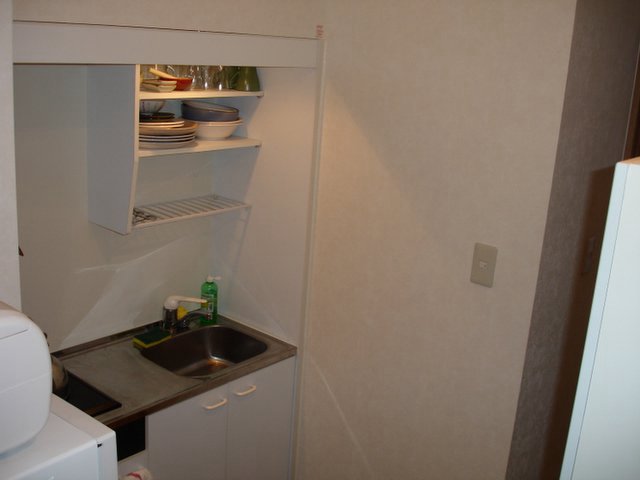
Through the kitchen is a long narrow hallway which leads to the front door:

Off of the hall is one door, which opens into a small space which holds my washing machine.

And finally, off of that space is the door for my tiny cellular bathroom:

And that's it for the inside. I have a small balcony just wide enough to stand on, with a somewhat less than exciting city view:

This month there is additional excitement off my balcony to the left-- They've been knocking down a 6-story building, a chunk at a time, it seems.
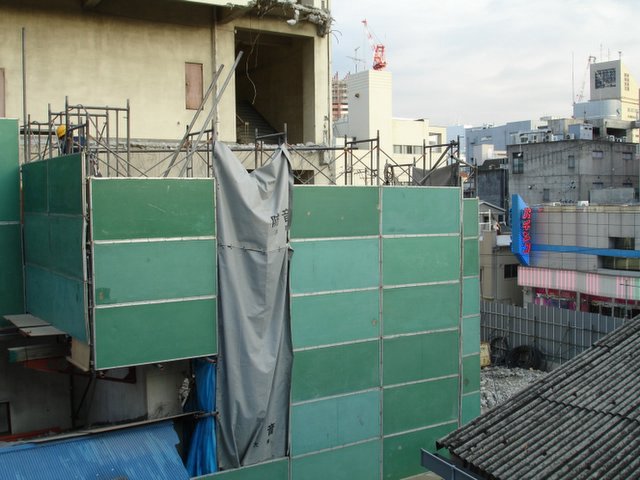
Here's a view of the fun from the next street over:

Luckily, I'm already up and around by the time the construction starts, so it doesn't really bother me. I suppose another building will go up, hopefully a little more pleasant to look at than the rust-stained wall that was there before. My view certainly doesn't compare to the one I had last year in Tottori:


I do miss Tottori sometimes... 懐かしい。。。
早口言葉
Some Japanese tongue-twisters I came across... Try them...
Alguém sabe como dizer "tongue-twister" em português? Pode me dar exemplos disso em português?
| この竹をこの竹垣に立てかけたのは、竹を立てかけたかったから、立てかけたのです。 Kono take o kono takegaki ni tatekaketa no wa, take o tatekaketakatta kara, tatekaketa no desu. The reason I have leaned this bamboo against this bamboo fence is that I just wanted to lean bamboo against it. |
| 東京特許許可局、今日急きょ許可却下。 Toukyou tokkyo-kyokakyoku, kyou kyuukyo kyoka kyakka. The Tokyo patent office hurriedly rejected the approval today. |
| スモモも桃、桃も桃、スモモも桃も桃のうち。 Sumomo mo momo, momo mo momo, sumomo mo momo mo momo no uchi. Japanese plums are a kind of peach, a peach is also a peach; both Japanese plums and peaches are kinds of peaches. |
| この子に常夏のココナツ九つ、あの子にも常夏のココナツ九つ。 Kono ko ni tokonatsu no kokonatsu kokonotsu, ano ko ni mo tokonatsu no kokonatsu kokonotsu. Nine everlasting coconuts to this child, nine everlasting coconuts to that child too. |
| 鹿もカモシカも鹿だが、しかし、アシカは鹿ではない。 Shika mo kamoshika mo shika da ga, shikashi, ashika wa shika de wa nai. Deer and antelope are both kinds of deer, but seals are certainly not deer. |
Alguém sabe como dizer "tongue-twister" em português? Pode me dar exemplos disso em português?

2005/11/14
Japanese Brazilian Return Migration and the Making of Japan's Newest Immigrant Minority
I think most people are surprised when they learn of the large Brazilian population in Japan, and also of the large Japanese population in Brazil. Here is a very good article which can provide some backgroud information for the curious.
I think what he says about the identity issues of Brazilians, towards the end of the article, holds true for most other immigrant populations in Japan as well. One of my Japanese-Peruvian friends, for example, has lived in Japan since he was 14 years old, speaks fluent Japanese, and even works now as an interpreter for the police department here. Outside of work, however, he shuns being identified as Japanese to the point where he refuses to speak Japanese in most situations, pretending not to understand when being spoken to. He identifies himself as Peruvian. He says that when you learn to speak Japanese well, your personality changes, since to speak Japanese like a native you must obey the etiquette rules of Japanese to hide your foreign-ness, holding back comments, gestures and opinions you might otherwise say in your native language. He doesn't seem to like putting forward the Japanese side of himself; he spends most of his time outside of work hanging out with other foreigners, speaking Spanish, English, or Portuguese.
And he speaks Japanese fluently-- Most foreigners, even part-Japanese foreigners here do not, whether they are Peruvians, Brazilians, Americans, Philipinos, etc.
I think what he says about the identity issues of Brazilians, towards the end of the article, holds true for most other immigrant populations in Japan as well. One of my Japanese-Peruvian friends, for example, has lived in Japan since he was 14 years old, speaks fluent Japanese, and even works now as an interpreter for the police department here. Outside of work, however, he shuns being identified as Japanese to the point where he refuses to speak Japanese in most situations, pretending not to understand when being spoken to. He identifies himself as Peruvian. He says that when you learn to speak Japanese well, your personality changes, since to speak Japanese like a native you must obey the etiquette rules of Japanese to hide your foreign-ness, holding back comments, gestures and opinions you might otherwise say in your native language. He doesn't seem to like putting forward the Japanese side of himself; he spends most of his time outside of work hanging out with other foreigners, speaking Spanish, English, or Portuguese.
And he speaks Japanese fluently-- Most foreigners, even part-Japanese foreigners here do not, whether they are Peruvians, Brazilians, Americans, Philipinos, etc.
2005/11/13
浜松城公園
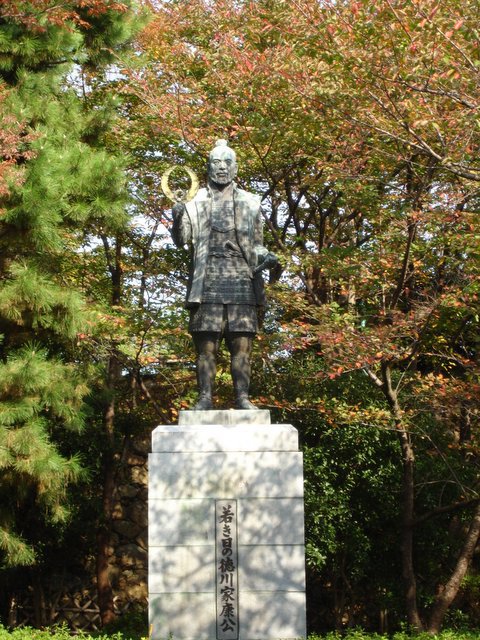
In front of Hamamatsu castle is a bronze statue of its builder, Ieyasu Tokugawa, who is considered perhaps the greatest shogun and one of the three people most important people to the unification of Japan. Tokugawa lived here from 1571 to 1588.
The English brochure they provide at the castle museum says:
Hamamatsu Castle is positioned at the southeast tip of the Mikatahara Plateau. It was built by Tokugawa Ieyasu, whose rule founded the Edo Period (1603-1867). Ieyasu was born in 1542, and spent 17 years at Hamamatsu Castle, from the age of 29 to 45.
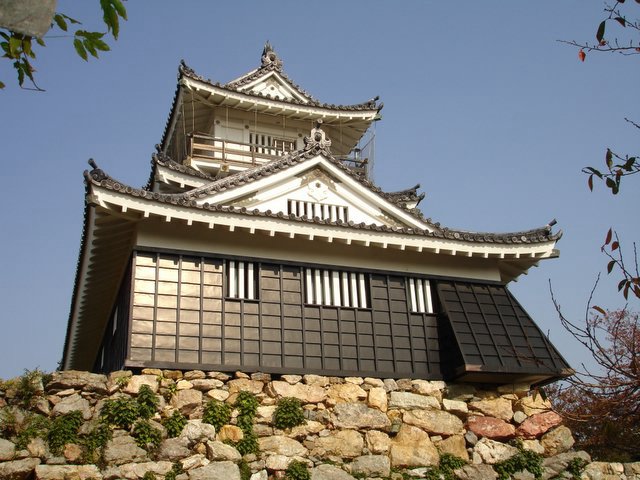
During this time, many famous battles took place, including the Battle of Mikatagahara in 1572, which was one of the toughest battles fought by Ieyasu. Although Ieyasu's 17-year stay at Hamamatsu Castle endured many difficult years, it did commence 300 years of glorious Tokugawa history.

The Lords of Hamamatsu Castle after Ieyasu were always to be very influential figures. In particular, Mizuno Tadakuni, one of the Lords, was credited with reforming the Tempo Era. As a result, Hamamatsu Castle is known as the 'Castle of Success'.
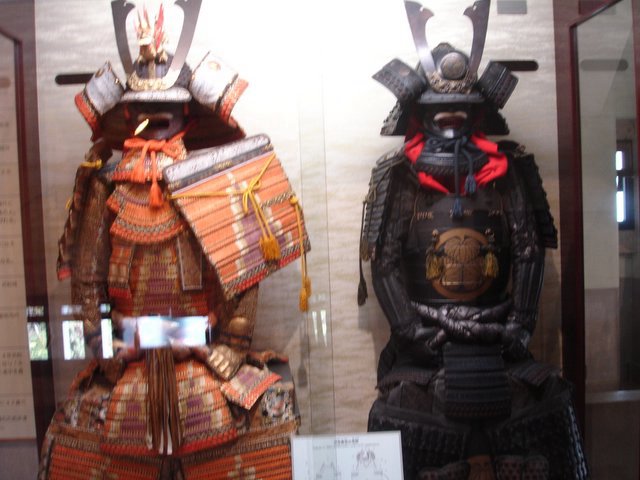
The boundary walls of the castle stretched approximately 500 meters from north to south, and 450 meters from east to wast. The castle tower, dungeon, and the 2nd and 3rd buildings were all in a straight line. After the end of the Edo Period, the castle buildings were completely devastated. However, in the spring of 1958, thanks to the efforts of the people of Hamamatsu, the tower of Hamamatsu Castle was re-built, and on June 1st of the following year, it was established as a historical site.

This is a well in the basement of the castle.
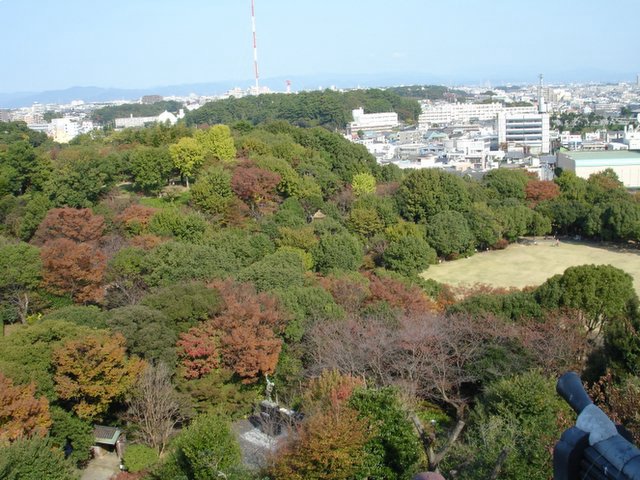
North of the castle is a very big park with a Japanese garden, a ceremonial teahouse, and some commons areas.

I don't know who this guy is, but he didn't look very happy to see me. (click to enlarge)

Some high school kids hanging out in the park. Notice how some of them are wearing their school uniforms even on Sunday. Can you imagine American kids liking school uniforms so much that they'd wear them when they didn't have to?

Very tall bamboo stalks.
五社神社


Evidently I live in one of the oldest neighborhoods in Hamamatsu. This morning I went to Gosha Shrine, just a couple of blocks from my place, and right next door to Hama Hall. I don't know a whole lot about it, but I suppose it has been around for a long time, because it appears in a miniature model I saw, in Hamamatsu Castle, of Hamamatsu in the period between 1603 and 1867. In the model, there is another shrine just next door to Gosha, but I didn't see another one, so perhaps that one has been destroyed. I also don't really know what was going on at the shrine this morning. There was a woman dancing with bells inside, and a load of dressed up families out front taking pictures of their children in kimonos. I couldn't resist taking some myself.
Esse templo é bem perto do meu apê aqui no certo de Hamamatsu. Não sei o que estava acontecendo hoje de manhã, mas foi irrestitível tirar fotos dessas crianças vestidas de kimono e tal. Muito lindas!
アパートから近い神社でかわいい子供を見て思わず写真をとってしまった。。神社の歴史について何も知らない。知っている人がいたら声をかけてね。
2005/11/09
A walk around my neighborhood.

HLO. So yesterday after getting home early, I took a little walk around my neighborhood and took these photos... This first wonderful shop is half a block from my place.

Shabby Chic. For the not-so-stylish woman.

Is "poot" a Hebrew word? Is that kosher?

No idea...

Hey Buddy, I'll take a Caffé Americano with cream, and a knuckle sandwich. For here.

Well, IS it? You tell me!
(To be fair, the Japanese part says "sports cafe," so it's not totally random.)
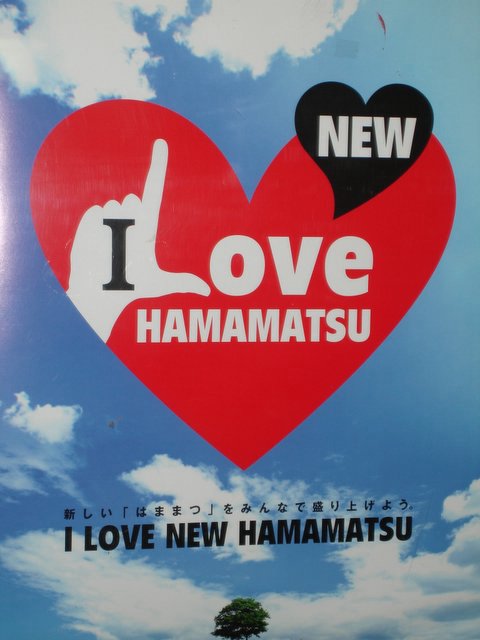
This publicity campaign was thought up by the previous CIR here, and accepted by the folks at city hall just before the CIR remembered that this gesture usually means "Loser" back home in the states.

Drawing upon my vast experience of dealing with construction tarps, I deem this to be one of the niftier construction tarps ever.

If my blog gets a little boring, remind me to go play a little pachinko so I can get more exciting.

Mommyyy... I gotta go weeee-weeeeeee...
Ok, hon.. just be back by 2AM.

Cocktailと言う単語はフランス語から来たので、cockともtailとも関係がないね。Tail of Cockとは昔の言葉で訳したら鶏の尻尾の意味だけど、現在の言葉では「チンチンの尻尾」の意味。それっていったい何?
登録:
コメント (Atom)